Mary Mettler, CSJ on behalf of the Federation Ecology Committee
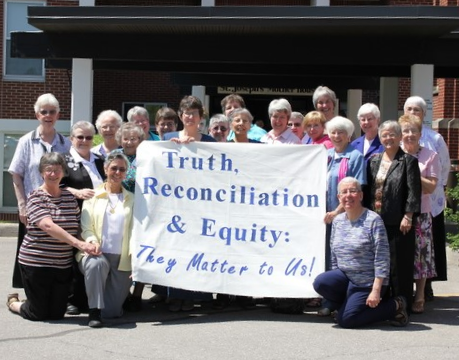
Through the Federation, we CSJs have become the 29th Blue Community in the world, joining with many others whose goals are: to have water and sanitation recognized as human rights, to phase out and then ban the sale of bottled water at municipal events and public facilities, and to promote publicly financed, owned and operated water and waste water services.
These communities are provided with the tools to fight the privatization of water and promote the human right to water. This project builds on nearly two decades of Water Watch work, in coalition with many other groups to promote and protect public water. Blue Communities in Canada, there are now 13 of them, is an initiative of the Council of Canadians and CUPE.
When Paris joined the Blue Communities Project on World Water day, 2016, Maude Barlow congratulated them saying “the global water crisis is getting more serious by the day and it is being made worse by the corporate theft and abuse of water.” And we all know of the problems our Aboriginal communities are experiencing with water that is not safe for drinking. Over 100 communities are under water advisory and need to boil water for drinking. And mercury contaminated water is major news and is a shame for Canada.
Indeed water scarcity is a global concern! In my recent awareness visit to India at the invitation of SOPAR, I came to a deep appreciation of water which we in Canada take so much for granted. In India, water is not lacking so much as it’s not potable and the contaminants lead to serious illnesses. Small village communities have built filtration plants to purify the water. Doctors were asked if this was really necessary. Their conclusion was that a village that had 5 doctors now only needed one. (see www.soparbalavikasa.org).
During her time in South Sudan on an awareness trip with Canadian Aid for South Sudan, Sister Joan Atkinson found similar realities. There they also have to deal with water-borne diseases causing illness and death. Taught by a Canadian scientist, they fill specific types of plastic bottles with water and let the ultra-violet rays of the sun purify the water. Families using this system are free of water-borne illnesses and are much healthier. I saw this same process being used while I was in Bolivia.
In a recent newsletter from the Office of Systemic Justice, Sister Sue Wilson writes “Water is indeed for our use and to sustain life but from an integral ecological perspective it is more than an “object for human use.”
HOW WOULD YOU DESCRIBE YOUR RELATIONSHIP WITH WATER?
Sister Sue quotes Denise Nadeau who writes “my journey to unlearn this objectification of water and experience water as a living relative continues to be a long one.” Our CSJ charism calls us into deep relationship with all creation, and I think of St. Francis of Assisi who addressed water as “Sister Water.”